
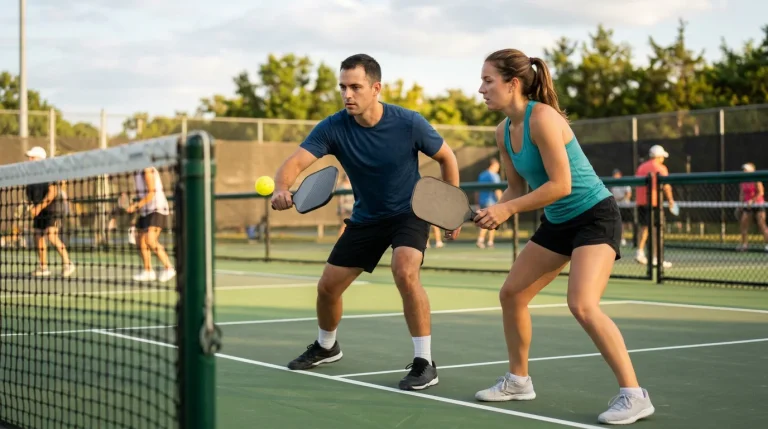
Pickleball Defense: When to Block, Counter, or Reset
A speedup is already flying toward your chest. Your paddle is up, your feet are set well enough, and there is no time for a full explanation of what is happening. Absorb the pace, fire back, soften the ball, or let it go?
The best answer is not always the most aggressive one. In the kitchen-line exchange, the right response depends on four quick reads: the ball’s height, your paddle preparation, your balance and court position, and what the opponent is doing after the attack.
Key Takeaways
- Counter high, balanced balls contacted in front.
- Block or reset when late, low, stretched, or jammed.
- Keep the paddle up and the swing compact.
- Bail only when you are sure the ball is out.
The First Read: Is the Ball Attackable?
Start with the ball, not your preferred shot. A speedup is simply a sudden acceleration out of a dink exchange, often aimed at the body, shoulder, or backhand. It may look like an invitation to counter, but the same speedup can be an easy attacking ball or a problem that needs to be absorbed, depending on where it reaches you.
A useful first question is: Can I contact this ball in front of me, at a manageable height, while staying balanced? If the answer is yes, a counter may be available. If any part of that answer is no, a block or reset is usually the higher percentage choice.
Height is the quickest filter. A ball clearly above net height and in front gives you room to direct it downward. A ball near net height can go either way. A ball below net height usually needs to be lifted, which makes a forceful counter more likely to pop up.
Many players use hip height as a practical coaching cue. Above the hip, look for an attacking window. Below the hip, expect to block or reset. It is not a rule, and experienced players can counter a low ball when their balance, timing, and paddle face are excellent. For most recreational rallies, though, it is a helpful default.
Contact position matters just as much as height. If the ball is in front of your lead hip, you can control the paddle face and choose a target. If it has reached your side or moved behind you, the clean swing path is mostly gone. That is a survival ball, not a chance to prove how hard you can hit.
The kitchen lines are only 14 feet apart, with each non-volley zone extending 7 feet from the net. That compact geometry explains why preparation matters so much. There is no time to take the paddle from your hip, load a big swing, and still be ready for the next ball.
Block When the Ball Has Taken Your Time
A block is the choice when the opponent has made you react. You are late, jammed, stretched, moving backward, or facing a ball that arrives too quickly for a clean attack. The goal is not to win the exchange immediately. The goal is to keep the ball playable and remove some of the attacker’s advantage.
The block is a compact volley. Keep the paddle in front, use little or no backswing, and let the incoming pace do much of the work. A relaxed grip helps the paddle absorb the ball instead of adding another burst of speed.
Aim with margin. A crosscourt block toward the opponent’s kitchen often provides more net clearance than a straight-ahead reply, but the important point is not to chase a narrow line. Get the ball low, preferably into the non-volley zone, and give yourself another decision.
If your blocks keep floating high, check three things before blaming your hands. You may be squeezing the grip, swinging backward, or contacting the ball beside your body instead of in front. Moving backward while reaching can also lift the ball because your paddle face and body are no longer working from a stable base.
A good block is not passive. It changes the rhythm of the rally. Once the pace is taken off, you and your partner have a chance to recover your spacing and prepare for the next ball.
Reset When You Need to Rebuild the Rally
A reset is the intended result of a soft defensive reply. You are trying to land the ball in the opponent’s non-volley zone so the opponent cannot continue attacking comfortably. A block describes how you make contact. A reset describes what you want the ball to do afterward.
Reset when you are low, late, stretched, off-balance, or unable to make clean contact in front. The mechanics are quiet. Keep the paddle in front, avoid a large swing, soften the grip, and add only enough upward motion to clear the net.
The reset needs margin. If it lands deep, high, or outside the kitchen, the opponent may attack again. A soft ball is not automatically a reset. It becomes a reset when it takes away the opponent’s easy speedup.
Do not assume a reset requires an immediate retreat. If you are balanced near the kitchen, hold your position and reload. If you are already moving backward or have been pulled wide, regain your balance before trying to charge forward. Court position is useful only when your body can support it.
Counter When You Own the Contact
Counter when the ball arrives at an attackable height, your paddle is prepared, your contact is in front, and your feet are stable. A counter is a short attacking response that uses the opponent’s pace rather than creating a long swing of your own.
The best counter is compact. Punch or redirect the ball with a firm, controlled paddle face, then recover immediately. You might send it toward the opponent’s feet, body, or open court, but the target should match the contact you actually have. A rushed attempt at a tiny corner is rarely better than a solid ball through the available space.
High contact gives you more options. A short forward or slightly downward counter can force the opponent to handle the ball from a difficult height. At middle height, stabilize the paddle and punch through the ball without chasing extra power. At low contact, resist the urge to swing hard. Unless the ball is unusually manageable, soften it into a reset instead.
Counter first is useful advice only when there is a real counter window. It does not mean counter every speedup. If the ball is below the net, behind your body, or arriving while you are drifting, a reset is not timid. It is the correct tactical choice.
Bail Only on a Confident Out Ball
Sometimes the smartest response is no contact. Let the ball go when you can confidently judge that it will land out and you can avoid it safely. That is a tactical decision, not a reaction to fear.
Do not use a blanket rule such as letting every chest-high ball pass. Height alone does not tell you whether the ball is going long. Read the ball’s line, depth, spin, and trajectory. A disguised speedup can dip inside the court, especially when it is aimed close to the sideline or baseline.
If the read is uncertain, protect the rally with a compact block or controlled counter. Under Rule 10.C.3 of the current USA Pickleball rulebook, after the serve, a ball that contacts a player or anything the player is wearing or carrying is a fault against that player, subject to the rule’s exception for the paddle and the paddle hand below the wrist. In practical terms, a late dodge can turn a playable ball into an immediate fault.
The Body Shot Needs Its Own Plan
A ball at the torso or hitting-arm area is difficult because it removes the space normally used for a forehand or backhand. The first priority is to create a small amount of room without making a large retreat.
Move the elbow or hitting arm to make space for the paddle. Keep the paddle face stable and in front of the ball. Do not take a backswing. Use a relaxed grip and absorb the pace, sending the reply low when possible.
This is where the cue move your elbow, not your feet becomes useful. It does not mean freezing your lower body. It means avoiding a panicked leap backward that lets the ball get behind you and gives up your court position.
A body shot can still be countered when it arrives high, clearly in front, and with enough room for a compact swing. That is different from a ball already crowded against your hip or chest. When the contact zone disappears, block first and worry about attacking later.
For a 3.0 player who freezes at body speedups, pre-program the response: paddle up, elbow creates space, no backswing, relaxed grip, low target. For a 4.0 or higher player, the same sequence creates the platform for a counter when the ball offers a genuine opening.
Use the Four Question Read
You do not need to recite a long checklist during a firefight. Practice these questions until they become one fast read.
- Height: Is the ball above, near, or below my comfortable contact height?
- Preparation: Is my paddle already up and in front, or am I starting late?
- Balance: Can I contact in front without reaching, drifting, or stepping backward?
- Recovery: Is the opponent’s paddle down, neutral, or already waiting?
The first three questions tell you whether you can attack. The fourth tells you whether attacking is worthwhile. A high ball that you can counter cleanly may still deserve a safer reply if the opponent is fully prepared and waiting for your pace.
A simple mental translation is enough. High, ready, balanced means counter. Low, late, or jammed means block or reset. Clearly out means bail. If the answer is mixed, choose the compact shot that keeps you in the rally.
Prepare the Paddle Before the Ball Is Hit
Fast hands are often prepared hands. Keep the paddle in front of your body during a kitchen exchange rather than resting it beside your hip. A neutral or backhand-ready position helps protect the middle and gives you a short path to a block.
That position should not become a rigid pose. Keep the grip relaxed enough to absorb pace, keep your wrist and forearm comfortable, and use your feet when the ball is clearly moving away from your center. The ready paddle buys time, but it does not replace movement.
After every block, reset, or counter, return the paddle to neutral. Many rallies are lost after a successful first defense because the player watches the ball instead of reloading. The opponent’s next shot may arrive before there is time to rebuild the swing.
You also do not need a universal distance from the kitchen line. Stay close enough to contest short balls, but give yourself the balance and reaction space required by the pace you are seeing. Against a hard hitter, a small adjustment can help, provided it does not turn into a retreat on every attack.
Read the Opponent’s Recovery
The opponent’s paddle tells you whether your counter has a chance. If the attacker’s paddle is down, their body is still recovering, or they are leaning after the speedup, a compact counter may catch them before they are ready.
If the opponent is already neutral and balanced, counter only when you have a clean contact and a sensible target. If their paddle is up and waiting, a soft block or reset may be wiser than feeding another fast ball into a prepared defender.
This is the part many players miss. The decision is not only about whether you can hit the ball hard. It is about whether the opponent is ready for the ball you are sending. A reset can be the better attacking decision when it forces the other team to build the next shot from a low position.
Practice the Decision, Not Just the Speed
A useful hands drill starts with two players near the kitchen line, paddles up and ready. Begin with a controlled exchange or feed. Then let the feeder add a speedup toward the defender’s body, middle, or shoulder.
The defender chooses a block, reset, counter, or let-go response based on height, balance, contact position, and the opponent’s recovery. After each ball, both players return their paddles to neutral. Switch roles regularly so the drill develops reading as well as attacking skill.
Start slowly enough to make the correct decision. Increase the pace only when the defender can respond without a large backswing or a panicked retreat. The purpose is not to create the fastest possible feed. It is to connect the visual read to a compact movement.
You can make the drill more realistic by having the feeder vary the target. A shoulder ball may require an elbow adjustment. A high ball in front may invite a counter. A low ball toward the feet should usually produce a reset. A ball clearly tracking beyond the line gives the defender a chance to practice leaving it.
Ask your partner for feedback on one item at a time. Was the paddle up? Was contact in front? Did the ball arrive above or below the net? Did the opponent recover before the reply? Focusing on one cue keeps practice useful instead of turning every miss into a debate about technique.
Five Mistakes That Steal Your Options
Taking a backswing. A large swing takes time you do not have and leaves you late for the next ball. Compact does not mean weak. It means efficient.
Squeezing the grip. Tension makes it harder to absorb pace and often sends the ball high. Hold firmly enough to control the paddle, but do not squeeze through every contact.
Retreating automatically. Moving backward can make a ball feel less threatening, but it also gives up the kitchen and often creates a poor contact point. Move because the ball requires it, not because it is fast.
Countering a jammed ball. If the ball is beside or behind you, a full attack usually creates a weak or wild reply. Create room, block, and recover.
Admiring a good defense. A block that lands in the kitchen is only one part of the exchange. The next ball may be coming before you have finished appreciating it.
The Answer Is Usually the Shot You Can Reload From
The fastest decision is not block versus counter in the abstract. It is whether the ball gives you control of the contact. When it is high, in front, and balanced, use a compact counter. When it is low, late, stretched, or jammed, absorb the pace and reset. When it is clearly out, get your body and paddle out of the way.
That choice becomes automatic through preparation. Keep the paddle up, read the height early, protect your balance, and watch the opponent’s recovery. In the middle of a hands battle, composure is not waiting for the perfect ball. It is recognizing the ball you have and choosing the response that leaves you ready for the next one.
Frequently Asked Questions (FAQs) for Pickleball Defense: When to Block, Counter, or Reset
Should I always counter a speedup that comes above the net?
No. Above-net height is an opportunity, not an obligation. Counter only when the ball is in front, your base is stable, and the opponent is not already prepared to handle your reply. If you are reaching or moving backward, block or reset instead.
What is the difference between a block and a reset?
A block is the compact defensive contact used to absorb or redirect pace. A reset is the result you want when the ball lands softly in the opponent’s non-volley zone. You can use a block motion to produce a reset.
How should I defend a speedup aimed at my backhand hip?
Keep the paddle in front, create space with a small elbow adjustment, and avoid a backswing. If the ball is low or behind your contact zone, absorb it and reset. Counter only when you can strike cleanly in front.
Should I step back from the kitchen against a hard hitter?
Adjust only as much as needed to stay balanced and see the ball. There is no universal distance that works for every player or pace. Avoid automatic retreat, since giving up the line can make short balls harder to reach.
How can I stop popping up my defensive blocks?
Start with a relaxed grip and a quiet paddle. Remove the backswing, contact in front when possible, and check whether you are drifting backward. Aim for a soft, crosscourt path into the kitchen rather than trying to guide the ball with a large motion.