
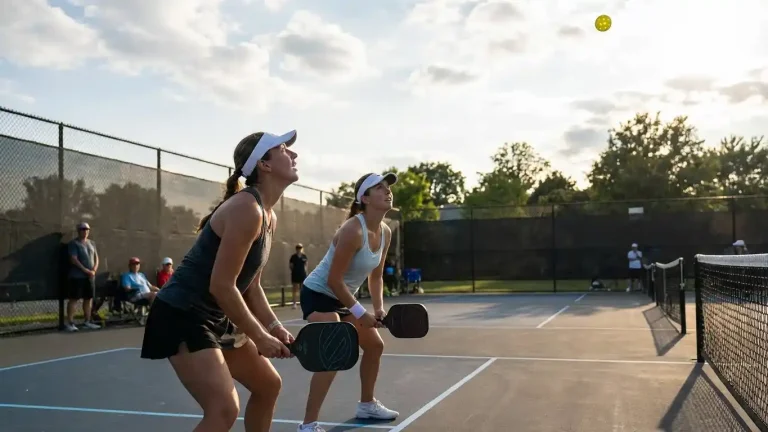
Pop-Ups: A Guide to Letting Lobs Go
That moonshot lob isn’t a winner, it’s already flying to another time zone. Learn how players worldwide read height, spin, and court depth to simply point, shout “Bounce it!” and pocket free points.
Key Takeaways
- Accurate lob defense requires assessing height, arc, and opponent positioning instantly.
- If a ball is 2-3 feet above your opponent’s reach, it is statistically likely to land out.
- Partners must communicate cues like “Bounce it!” or “No!” to prevent faulty smashes.
- Proper footwork involves pivoting to “open the door” rather than dangerous backpedaling.
- Environmental factors in facilities like Rhythm and Rally or City Pickle affect depth perception.
The High Ball Seduction: A Universal Pickleball Trap
We have all been there. You are standing at the non-volley zone, paddle ready, feeling like a predator waiting for lunch. Suddenly, your opponent sends a high, arcing shot soaring into the sky. It looks juicy. It looks like the perfect opportunity to slam the ball down and end the point with an emphatic, glorious smash.
But then, disaster strikes. You leap, you swing with all your might, and the ball sails directly into the back fence. Or worse, you realize halfway through your swing that the ball was actually drifting five feet past the baseline. You just smashed an out-ball, handing your opponents a free point and a boost of confidence.
This is the emotional cycle of the lob hook. It is a psychological trap as much as a physical shot. The urge to smash—often called “lob temptation”—can override your better judgment. Coaches and players worldwide report frustration with this phenomenon, noting that the emotional desire to hit the ball often defeats logical spatial awareness. Mastering the discipline to let the ball fly is one of the quickest ways to level up your game.
The Lob Decision Tree: To Smash or Not to Smash
Making the right call on a deep lob happens in a split second. You need a mental checklist, or a “decision tree,” to process the trajectory of the ball. This isn’t just about guessing; it is about calculating specific variables like height, arc, and spin.
Analyzing Height and Arc
The first clue lies in the apex of the lob’s flight. Research into decision-making strategies suggests a specific visual benchmark. If the ball is more than 2-3 feet above your opponent’s fully extended reach as it passes over them, it is highly likely to land out.
This requires you to watch the ball relative to the player, not just the sky. A high-arcing shot, often used defensively to buy time, has a steep descent. However, the momentum required to get it that high often carries it deep. If you see that distinct height gap, your brain should immediately switch from “attack mode” to “watch mode.”
Reading Spin and Trajectory
Spin is the hidden variable that ruins many well-planned defenses. A ball hit with heavy topspin will dive aggressively at the end of its flight, potentially dropping in just inside the baseline. Conversely, a flat lob or one with backspin will float and carry further than you expect.
Global players emphasize reading these tendencies early. If your opponent has a short, punchy stroke, the ball might float long. If they brush up the back of the ball aggressively, expect it to drop. You must combine this read with the arc of the shot to predict the bounce point accurately.
Assessing Depth and Positioning
Your position on the court is the final piece of the puzzle. Are you hugging the kitchen line, or are you in the transition zone? The deeper you are, the more likely a high ball is to drift out.
Key decision tree elements include assessing the opponent’s back position and your own distance from the baseline. If you are already two steps off the kitchen line and the ball is still soaring well over your head, let it go. Tracking the ball relative to the sideline or center line can also help provide depth perspective, creating a grid for your spatial awareness.
Mastering the “Bounce It!” Call
Pickleball is a team sport, and defending against the lob is where partnership truly shines. You cannot see the baseline behind you, but your partner can. This is where verbal communication becomes your most valuable piece of equipment.
The Vocabulary of Defense
Partners train specific verbal cues to sync their spatial reads. The most effective command is a loud, decisive “Bounce it!” This tells the player targeting the overhead that the ball is deep and questionable. It is permission to disengage from the smash.
Other teams use “No!”, “Let it go!”, or simply “Out!” The specific word matters less than the speed and volume of the call. The goal is to break the “lob temptation” trance. When you hear your partner scream “Bounce it,” you must trust them immediately and pull back your paddle.
Building Trust in Doubles
This communication builds a safety net. In doubles, the partner who is not chasing the ball has a static view of the court geometry. They can judge the trajectory against the background and the lines much better than the player moving backward.
Practice drills for players often focus on this interaction. Partners work to build automatic “leave it” calls. The discipline to leave out-balls wins free points. It saves you from the error of hitting a ball that was destined for the fence, turning a potential loss of point into a guaranteed winner without swinging your paddle.
Spatial Awareness and Footwork Mechanics
Once you have decided to let the ball go or chase it down, your feet need to move correctly. Bad footwork on overheads is a leading cause of injury and poor execution.
The Safety Move: Pivot, Don’t Backpedal
The golden rule of overhead movement is never to run backward. Backpedaling is slow and dangerous; it is easy to trip and hit your head. Instead, experts advise you to prioritize a safety move. Pivot your body sideways to “open the door.”
This pivot allows you to shuffle or run toward the baseline while keeping your eyes on the ball (and avoiding a trip to the ER). It puts you in a strong athletic position. From here, you can decide whether to leap for a smash or continue running to let it bounce.
Determining the Bounce Point
If the lob is deep—specifically past the baseline—your job is to run beyond the ball. Do not just stop at the line and hope. Run past the theoretical bounce point.
Expert takes suggest that for deep lobs, you should track the bounce point and call out regardless of your overhead readiness. If the ball lands out, you are there to confirm it. If it lands in, being behind the ball allows you to hit a defensive drop or lob return. You cannot hit a quality shot if you are reaching behind your head while falling backward.
Courts: Environment Impacts Decision Making
Judging a high ball isn’t the same everywhere. The background, lighting, and ceiling height of different facilities dramatically change your depth perception.
Strategic Responses: What If It Lands In?
Sometimes, you let the ball go, and it lands good. It happens. You need a backup plan. The contrarian view is that defensive lobs buy a second chance post-smash, so you must be ready to reset.
The Reset Drop
If the ball bounces in deep, do not panic. Do not try to blast a winner from five feet behind the baseline. Your best option is a drop shot. Soften your grip and gently push the ball back into the opponent’s kitchen. This resets the point and allows you to move back to the non-volley zone.
The Overhead Smash
If you read the lob early and it is short—meaning you don’t have to backpedal—take the overhead. Aggressive overhead players will punish short lobs. Snap your wrist and aim for the open court or directly at the opponent’s feet.
Avoid the Counter-Lob
A common mistake is to lob the ball back immediately. Unless you are desperate, avoid this. Research indicates that lobbing back gives opponents setup time to crush an overhead. It puts you back on the defensive. Try to drive or drop the ball to neutralize their advantage.
Cultivating Discipline and Patience
The difference between a 3.5 player and a 5.0 player is often the discipline to do nothing. It is the ability to watch a ball fly over your shoulder, point at it, and watch it land three inches out.
Analyzing the “Juicy” Factor
Beginners often misjudge depth, leading to faults. They see height and assume “easy shot.” players emphasize reading tendencies. If an opponent is scrambling, their lob is likely defensive and might be erratic.
Reddit users and coaches report that the emotional urge to smash is a primary leak in many games. You must train your brain to enjoy the “leave” as much as the “smash.” There is a unique satisfaction in watching an opponent’s hope evaporate as their shot lands long.
Practice Drills for Discipline
To fix this, you need reps. Drill with a partner where one person feeds high balls and the other simply calls “In” or “Out” without hitting them. Practice pivoting and running back to the baseline.
Partners train verbal cues like “No!” or “Bounce!” during these drills. The goal is to reach a state where the communication is instant and the physical reaction is automatic. You want to achieve a high “let-go” rate on marginal balls. If it is close, let it bounce. You can always hit it after the bounce if it stays in.
Frequently Asked Questions (FAQs) for Lob Decision Making
What is the “decision tree” for judging pickleball lobs?
The decision tree is a mental checklist used to judge if a lob is in or out. It involves assessing the height (2-3 feet over reach usually implies out), the arc trajectory, the spin, and the depth relative to your court position.
How does spin affect where a lob will land?
Spin drastically changes the ball’s flight. Heavy topspin causes the ball to dive quickly, often keeping deep shots in play. Backspin or flat shots tend to float and carry further, making them more likely to sail long.
Why is backpedaling dangerous when chasing a lob?
Backpedaling is unsafe because it increases the risk of tripping and hitting your head. It is also slower. The correct technique is to pivot sideways and shuffle or run forward toward the baseline to track the ball.
What should I shout to my partner if I think a lob is going out?
You should shout a clear, loud command like “Bounce it!”, “No!”, or “Leaf it!” The key is immediate volume to break your partner’s focus on the smash and alert them to the depth of the ball.
Why shouldn’t I lob the ball back if I retrieve a deep shot?
Lobbing the ball back usually gives your opponents ample time to set up for an overhead smash. It keeps you on the defensive. A better option is usually a drop shot or a drive to reset the point.